
AR, VR and Mixed Reality: Definitions, Uses and Limits
Augmented reality (AR) adds digital content to a view of the real world, virtual reality (VR) places you in a computer-generated environment, mixed reality (MR) merges the two, and extended reality (XR) is the umbrella term that covers them.[1, 2] They are not interchangeable. This page explains the differences, a short history, where they are used and what limits them.
Short answer
- AR, VR and MR are defined by how digital content relates to the real environment. Milgram and Kishino placed them on a “virtuality continuum” between completely real and completely virtual environments.[1]
- XR is an umbrella term for all of them, not a fourth kind of display.[2, 3]
- “Mixed reality” has an original, wide definition and a narrower common usage, which is why it is the term most often confused.[1]
How to read this page. Numbers in square brackets point to the sources under References. A statement without a number is our own plain-language explanation, not a research finding. Labels mark each use as Established or In development. We checked all sources on 28 October 2026.
What do AR, VR, MR and XR mean?
The terms describe where digital content sits between the real and the virtual. The diagram places them on the continuum, and the cards give each definition.
The reality–virtuality continuum, with the terms placed on it
XR (extended reality): an umbrella term that includes VR, AR and MR.[2]
MR (mixed reality), original definition: anywhere between the two ends. It includes AR and augmented virtuality.[1]
- Real environmentOnly real objects, such as a direct view of a real scene.[1]
- Augmented realityA real environment augmented with virtual objects.[1]
- Augmented virtualityA mostly virtual world augmented with real-world content.[1]
- Virtual environmentOnly virtual objects, such as a computer graphic simulation.[1] Headset “VR” sits at this end.
More realMore virtual
-
Augmented reality (AR)
- Definition
- Any case in which an otherwise real environment is “augmented” by means of virtual (computer graphic) objects.[1]
- Real world visible?
- Yes. The real environment is the main thing you see, with digital content added.[1]
- Typical features
- A review quotes Azuma’s properties for AR systems: they combine real and virtual objects in a real environment, run interactively and in real time, and geometrically align virtual and real objects.[4]
- Common mix-up (our explanation)
- AR is not the same as VR: you are not placed inside a fully computer-generated world.
-
Virtual reality (VR)
- Definition
- At the “virtual” end of the continuum: environments consisting solely of virtual objects, for example a conventional computer graphic simulation.[1] The W3C describes VR as involving “immersive computer-mediated experiences”.[3]
- Real world visible?
- Not in the virtual environment itself.[1]
- Typical features
- Headsets that present an immersive view and track the wearer; the FDA authorised one prescription “immersive virtual reality system” for chronic low back pain.[5]
- Common mix-up (our explanation)
- “VR” is often used loosely for any headset, including see-through ones that are not VR.
-
Mixed reality (MR)
- Definition
- Milgram and Kishino: the merging of real and virtual worlds somewhere along the virtuality continuum, anywhere between the two extremes. In their original usage this includes AR.[1]
- Real world visible?
- Yes, in varying proportion, depending on where a system sits on the continuum.[1]
- Common usage (not a formal definition)
- Many products use “MR” for digital content anchored to, and responding to, real surfaces and objects. We found no standards-body definition that says this, so treat it as common usage.
- Common mix-up (our explanation)
- People use MR and AR interchangeably, but in the original definition MR is the wider term.
-
Extended reality (XR)
- Definition
- The OpenXR specification says XR refers to a continuum of real-and-virtual combined environments generated by computers through human-machine interaction, inclusive of VR, AR and MR technologies.[2] The W3C describes XR as the spectrum of hardware, applications and techniques used for virtual reality or immersive environments.[3]
- Real world visible?
- Depends on which kind of experience is meant.
- Common mix-up (our explanation)
- XR is not a fourth kind of display alongside AR, VR and MR. It is an umbrella for all of them.
| Term | How digital content relates to the physical environment | Real world in view? | Basis |
|---|---|---|---|
| AR | Virtual objects are added to a real environment. | Yes | Milgram and Kishino’s definition.[1] |
| VR | The user experiences an environment made of virtual objects; headset VR is described as immersive. | No, within the virtual environment | Milgram and Kishino; W3C.[1, 3] |
| MR | Real and virtual are merged somewhere along the continuum. Many products use it for content that is anchored to and responds to real surfaces. | Yes, in varying proportion | Milgram and Kishino for the original definition;[1] the product usage is not from a source we checked. |
| XR | Umbrella term for AR, VR, MR and related technologies. | Depends on the experience | OpenXR specification; W3C.[2, 3] |
Our interpretation: when someone says “mixed reality”, it is worth asking which definition they mean: the original wide one from research, or the narrower product one. Nothing in the sources we checked fixes a single meaning.
What is the history of AR, VR and MR?
These ideas are decades old. The milestones below are the ones the sources we could check support.
| When | What happened | Note |
|---|---|---|
| 1968 | Ivan Sutherland’s experimental 3-D display, described by the Computer History Museum as probably the first head-mounted stereoscopic display. It was suspended from the ceiling to reduce the weight on the wearer’s head.[6] | Sources differ on the institution and collaborators. |
| 1994 | Milgram and Kishino published the “virtuality continuum” and the taxonomy of mixed reality displays.[1] | Concerns visual displays only. |
| 1997–2017 | Palmarini and colleagues reviewed 30 studies from these years on AR in maintenance, noting that AR for maintenance has been an academic research topic for around 50 years.[4] | Their own statement; dates are the review period. |
| 2020 | Radianti and colleagues published a systematic review of immersive VR in higher education.[7] | Abstract checked. |
| 2021 | The W3C published its note on XR accessibility.[3] The FDA received a De Novo request in March 2021 for a prescription VR system for chronic low back pain. Its decision summary grants the request and classifies the device type as class II.[5] | US regulator; this is one device. |
Where are AR, VR and MR used?
| Field | What the sources say | Status and limits |
|---|---|---|
| Education | A systematic review of immersive VR in higher education found that learning theories were not often considered in development, and that evaluation focused mainly on usability rather than learning outcomes.[7] | In development Abstract only; higher education only. |
| Training and manufacturing | A review of 30 studies on AR for industrial maintenance covered assembly or disassembly, repair, diagnosis and training, and concluded that AR still lacks maturity in some areas and that hardware, software and solutions are highly fragmented.[4] | In development Data to 2017. |
| Healthcare | The FDA authorised one prescription, in-home immersive VR system as adjunctive treatment for adults with chronic lower back pain. Its limitations say safety and effectiveness have not been demonstrated in patients with moderate to severe depression.[5] | Established For one device only. |
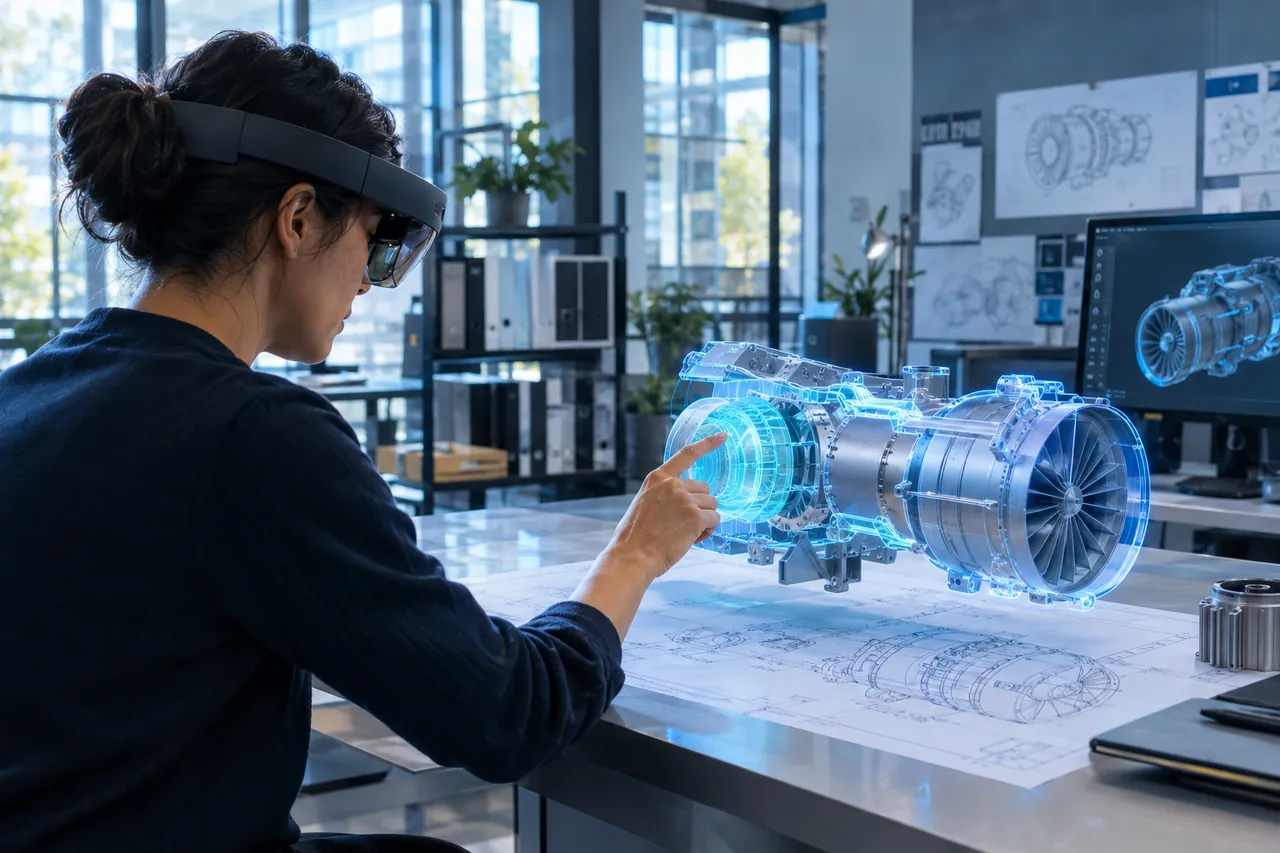
| Design | We found no source we could cite on how widely AR or VR is used for design. The feature illustration shows a design review scenario as an example of the idea. | Illustration only. |
| Entertainment | We found no source we could cite on entertainment use, so this page gives no figures. | Not sourced. |
What hardware, software and interaction methods do they use?
| Layer | What the sources describe | Note |
|---|---|---|
| Displays | The AR maintenance review grouped hardware into head-mounted displays, handheld displays (including mobiles and tablets), desktop PCs, projectors, haptic devices and sensors.[4] Milgram and Kishino’s classes of mixed reality display include monitor-based video displays as well as head-mounted ones.[1] | AR does not always need a headset. |
| Tracking | The review grouped tracking into model-based, features-based and marker-based approaches.[4] | Tracking is what lets digital content stay aligned to the real world. |
| Interaction | Interaction methods in the reviewed AR systems included text, audio and static or dynamic 2D and 3D content.[4] The W3C stresses a range of input mechanisms rather than only motion controllers.[3] | Hardware has moved on since the 2017 review period. |
| Software | OpenXR is an API (application programming interface) between XR applications and an XR runtime, which may handle frame composition, peripheral management and raw tracking information.[2] | An open standard from the Khronos Group. |
What are the limits, and what should users consider?
The sources we found support the points below. Where we found no source we say so rather than guess.
| Concern | What the sources say | Caution |
|---|---|---|
| Technical maturity | The AR maintenance review found high fragmentation among hardware, software and AR solutions, which makes selecting and developing systems complex.[4] | Data to 2017. |
| Comfort | The FDA decision summary for one VR system warns users to stop if they experience motion sickness, dizziness, headache or eye strain.[5] In that device’s clinical study, 9.7% of the treatment group and 6.7% of the sham group reported nausea and motion sickness, and 20.8% and 5.3% reported discomfort with the headset.[5] | One device and one study; not general rates. The survey was captured later than planned, according to the summary. |
| Accessibility | The W3C note covers the needs of people with disabilities in XR. It says users should be able to use a range of input mechanisms, to modify their input preference, and to have alternatives to interactions that may trigger epilepsy or motion sickness.[3] | A Working Group Note, not a set of baseline requirements. |
| Privacy | The ICO lists “immersive virtual worlds” among eight priority technologies and says immersive technologies can collect novel types of intimate information.[8] | A pointer, not detailed guidance; the page does not use the term XR. |
| Cost | We found no source we could cite on hardware or development costs, so this page gives no figures. | Not sourced. |
Our interpretation: most of the applications evidence we could check is about research and one authorised medical device. That tells us what has been studied, not how widely these technologies are used.
Common questions
Is AR the same as VR?
No. In AR the real environment remains the main thing you see, with virtual objects added. In VR the user experiences an environment of virtual objects.[1]
Is mixed reality just AR?
In Milgram and Kishino’s original definition, mixed reality is the wider term and includes AR.[1] Many products now use “mixed reality” for content that is anchored to and responds to real surfaces, so the meaning depends on who is using it.
What does XR stand for?
“Extended reality”. It covers VR, AR and MR and related technologies.[2, 3]
Do I need a headset for AR?
Not always. A review of AR in industrial maintenance included handheld displays such as mobile phones and tablets alongside head-mounted displays.[4]
Can VR make people feel unwell?
It can for some people. The FDA decision summary for one VR system tells users to stop if they experience motion sickness, dizziness, headache or eye strain.[5]
Is VR used in medicine?
In the US, the FDA authorised one prescription in-home VR system as adjunctive treatment for adults with chronic lower back pain.[5] That is one device, not VR in general.
References
Each source is listed in the order it is first cited. The note under each one says what it supports and how it was checked. Where only an abstract or summary page was read, the note says so.
- A Taxonomy of Mixed Reality Visual Displays. Paul Milgram and Fumio Kishino, IEICE Transactions on Information and Systems, E77-D(12), 1321–1329. 1994.Supports: the “virtuality continuum”, and the original definitions of mixed reality, augmented reality and augmented virtuality. Checked against the full text (PDF) of a copy hosted by a university course site. It concerns visual displays only and dates from 1994, so modern products are not described.
- The OpenXR Specification, version 1.0.34. Khronos Group, OpenXR Working Group. version 1.0.34 (no date checked).Supports: the specification’s description of XR and of OpenXR as an interface between applications and XR runtimes. Checked against the introduction of the specification (the page is very large; only the opening section was read).
- XR Accessibility User Requirements (Working Group Note). W3C Accessible Platform Architectures Working Group. 25 August 2021.Supports: the W3C’s description of XR, VR and AR/MR and the accessibility considerations quoted. The note says it is not a collection of baseline requirements. Checked against the page.
- A systematic review of augmented reality applications in maintenance. Riccardo Palmarini, John Ahmet Erkoyuncu, Rajkumar Roy and Hosein Torabmostaedi, Robotics and Computer-Integrated Manufacturing 49, 215–228. 2018 (accepted manuscript).Supports: the review’s findings on AR in industrial maintenance (30 studies, 1997–2017), the display, tracking and interaction categories, and its conclusion about fragmentation and limited maturity. Checked against the full text of the accepted manuscript. The data are up to 2017, so hardware has moved on since.
- De Novo Classification Request for EaseVRx, decision summary (DEN210014). U.S. Food and Drug Administration (FDA). request received 31 March 2021; the decision date is not legible in the copy we read.Supports: the indication for this one prescription virtual reality system, its limitations and warnings, and the adverse-event figures from its clinical study. The copy is a scanned PDF with some unreadable text. The figures apply to this device and study, not to VR in general. US regulator only.
- Ivan Sutherland’s experimental 3-D display. Computer History Museum. object dated 1968; no publication date shown.Supports: the date, the description as probably the first head-mounted stereoscopic display, and the ceiling suspension. Checked against the page. Sources differ on the institution and collaborators, so none are named here.
- A systematic review of immersive virtual reality applications for higher education: Design elements, lessons learned, and research agenda. Jaziar Radianti, Tim A. Majchrzak, Jennifer Fromm and Isabell Wohlgenannt, Computers & Education 147, article 103778. 2020.Supports: the review’s findings that learning theories were seldom considered and that evaluations focused on usability rather than learning outcomes. Checked against the abstract only (retrieved through a scholarly metadata service); the full text could not be downloaded by our tools.
- Tech Horizons report 2024. Information Commissioner’s Office (ICO), UK. no date shown on the page (second edition).Supports: the ICO’s inclusion of “immersive virtual worlds” among eight priority technologies and its general point that immersive technologies can collect novel types of intimate information. The page does not use the term XR and gives no detailed privacy analysis, so this is a pointer, not guidance. Checked against the page.