
Robotics Technology: Types, Components and Applications
A robot is a machine that can sense, make some decisions and act on the physical world. ISO, as quoted by the International Federation of Robotics (IFR), says robots require a “degree of autonomy”: the ability to perform intended tasks based on current state and sensing, without human intervention.[1] This page explains how robots differ from ordinary automated machinery, the main types, what they are made of, where they are used, and what limits them.
Short answer
- A robot is more than a machine that repeats a sequence: standards describe programmable, actuated mechanisms with a degree of autonomy.[1, 2]
- The main categories are industrial (including collaborative), mobile and service robots, with medical robots a third category in ISO 8373:2021.[1, 2]
- 542,076 industrial robots were installed worldwide in 2024.[3] Many advances in AI-enabled and humanoid robots are still in development.[4]
How to read this page. Numbers in square brackets point to the sources under References. A statement without a number is our own plain-language explanation, not a research finding. Labels mark developments as Established, In development or Forecast. We checked all sources on 28 October 2026.
What is a robot, and how is it different from automated machinery?
A robot is a programmable machine with some autonomy; automation is the wider idea of machines doing work with little human effort. The table uses the wording of the standards bodies and regulators we could check as anchors, and adds a simple contrast of our own.
| Question | Fixed automation (our simplification) | Robot (IFR/ISO wording) |
|---|---|---|
| Can it be reprogrammed? | Often built for one sequence of motions. | An industrial robot is “reprogrammable”: motions can be changed without physical alteration of the mechanism.[2] |
| How many axes? | Varies. | An industrial robot is programmable in three or more axes.[2] |
| Does it need some autonomy? | Not necessarily. | ISO says robots require a degree of autonomy, defined as the ability to perform intended tasks based on current state and sensing, without human intervention.[1] |
| What about remotely controlled tools? | — | The IFR calls a mechanism that does not meet all the characteristics of a robot, such as a tele-operated remote manipulator, a “robotic device”.[1] The FDA says a surgical system “is not actually a robot” because it cannot perform surgery without direct human control.[5] |
Our interpretation: the robotics definition is a bright line only on paper. The FDA’s wording shows how the same machine can be called a surgical system or a robot depending on how much it decides for itself. When a headline calls something a “robot”, it is worth asking how much it senses and decides without a person.
What is the history of robotics?
The history of robotics is long and its milestones depend on definitions. The table lists a few that sources support. It is not complete, and other sources give different dates and details.
| When | What happened | Note |
|---|---|---|
| 1954 | George Devol applied for a patent for a “Programmed Article Transfer” device; he later formed Unimation with Joseph Engelberger.[6] | One source’s account. |
| 1961 | The first Unimate was installed at a General Motors plant in Trenton, New Jersey, to assist a hot die-casting machine. It was hydraulically powered.[6] | Other accounts give different dates for the prototype and the installation. |
| 1966–1972 | SRI researched Shakey, which SRI calls the first mobile robot able to perceive and reason about its surroundings.[7] The Computer History Museum describes it as having cameras and touch sensors and being controlled by a large remote computer.[8] | “First” is SRI’s own claim. |
| 2021 | ISO 8373:2021 is the edition of the robotics vocabulary that the IFR cites; it adds medical robots as a third category.[1] In September 2021 Perseverance’s Auto-Nav completed a drive on Mars.[9] | Two unrelated events in the same year. |
| 2024 | 542,076 industrial robots were installed worldwide, and the operational stock was 4,663,698 units (+9%).[3] | IFR statistics for industrial robots only. |
What types of robot are there?
Robots are often grouped by what they do and where they work. The cards compare three broad categories. Other categories exist, such as medical robots (a third category in ISO 8373:2021) and humanoid robots.[1, 4]
-
Industrial and collaborative robots
- What it is
- ISO 8373:2021, as quoted by the IFR: an automatically controlled, reprogrammable, multipurpose manipulator, programmable in three or more axes, fixed in place or on a mobile platform, for automation in an industrial environment. Collaborative robots are designed to work with people; the IFR separates those that follow the ISO 10218-1 safety standard from those that do not.[2]
- Typical uses
- In 2024 the electronics industry accounted for 24% of new industrial robot installations and the automotive industry for 23%.[3]
- Benefits (our general explanation)
- Repeatable work, reprogrammable for new tasks.
- Limits
- The IFR says a collaborative robot that does not meet ISO 10218-1 is not necessarily unsafe, because it may follow other standards.[2] Safety depends on the standard and the application.
-
Mobile robots
- What it is (our explanation)
- Robots that move through their environment instead of staying fixed. The sources describe two examples: SRI’s Shakey, a research robot from 1966–1972,[7] and NASA’s Perseverance rover.[9]
- Typical uses
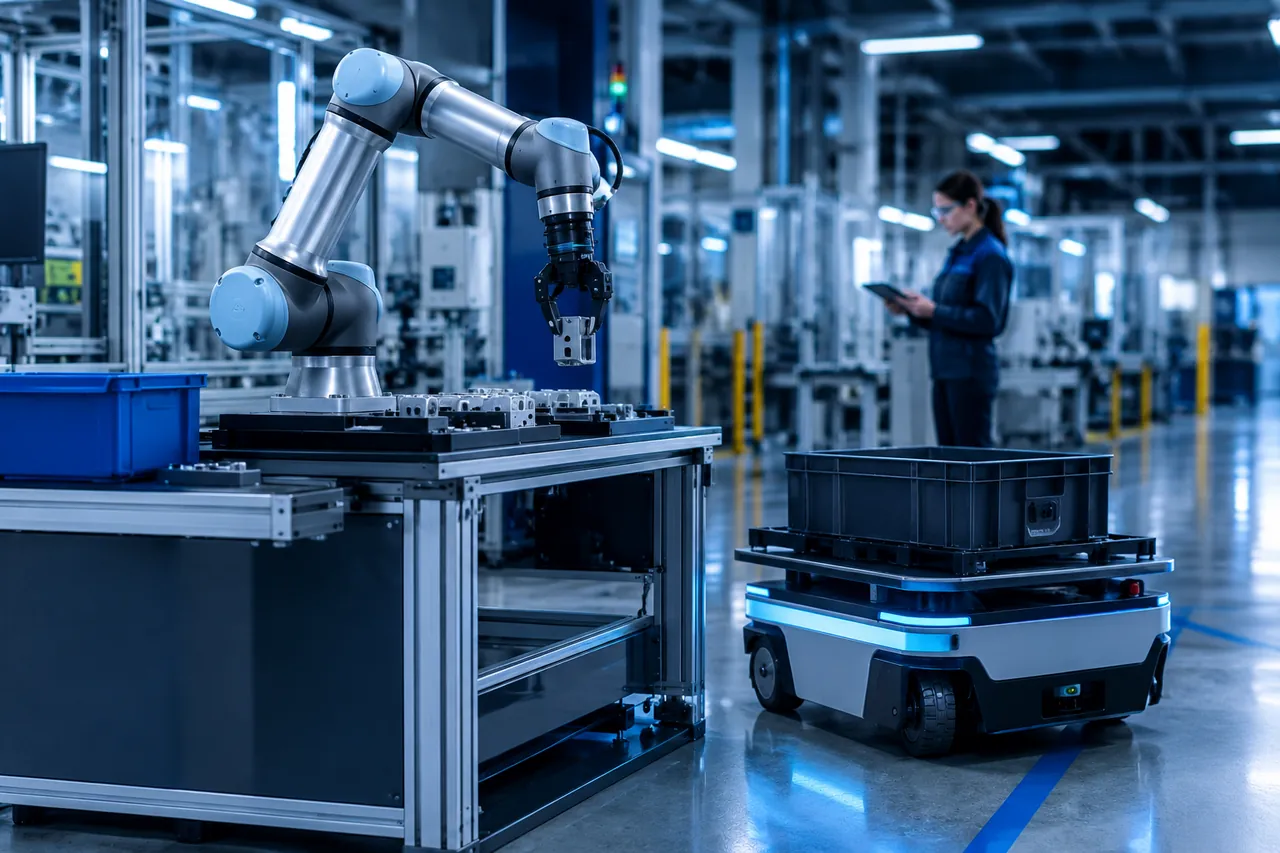
- Planetary exploration is the example we can cite. The illustration also shows a wheeled carrier in a factory; the sources we checked give no statistics for this use.
- Benefits
- After human drivers direct the first few metres so the rover can build a 3D terrain map, Auto-Nav lets Perseverance choose its own path to a target and re-plan around obstacles.[9]
- Limits
- Even this system relies on people to direct the start of each drive and to set the destination.[9]
-
Service robots (including medical)
- What it is
- ISO 8373, as quoted by the IFR: a robot in personal or professional use that performs useful tasks for humans or equipment. ISO 8373:2021 also defines medical robots as a third category.[1]
- Typical uses
- The FAO describes agricultural robots as a key trend in farming,[10] and the FDA describes robotically-assisted surgical systems.[5]
- Benefits
- The FDA says benefits of robotically-assisted surgery may include its ability to facilitate minimally invasive surgery.[5]
- Limits
- Autonomy ranges from partial to full, and some systems are tele-operated.[1] The FDA says its robotically-assisted surgical devices cannot perform surgery without direct human control.[5]
What are a robot’s main components?
Most robots can be understood as sensors, control software and actuators working together, with people overseeing them. That loop is a common way of teaching the idea; real robots differ in detail.
-
Part 1
Sensors
Measure the robot’s own state and its surroundings. Perseverance’s navigation relies on cameras and a map of its surroundings.[9]
- Cameras
- Touch sensors
-
Part 2
Control and software
Turns measurements into decisions. ISO describes a “degree of autonomy” as the ability to perform intended tasks based on current state and sensing, without human intervention.[1]
-
Part 3
Actuators
Parts that produce movement. In industrial robots these are the jointed or sliding segments of a manipulator that move along programmed axes.[2]
-
Part 4
Human oversight
People set goals, supervise and step in. Perseverance’s drivers direct the start of each drive,[9] and the FDA says surgical devices need direct human control.[5]
Where are robots used?
| Field | What the sources say | Status and limits |
|---|---|---|
| Manufacturing | Electronics (24%) and automotive (23%) were the largest customer industries for new industrial robots in 2024; for 14% of installations the customer industry was unknown.[3] | Established Supplier-reported statistics. |
| Healthcare | The FDA describes robotically-assisted surgical systems as devices that let surgeons move instruments through small incisions under direct control, and reports injury and death reports, mostly involving device malfunctions. It has not authorised any such device specifically for preventing or treating cancer.[5] | Established US regulator. |
| Logistics | We found no source we could cite for logistics robots, so this page gives no statistics. The feature illustration shows a wheeled carrier as an example of a mobile robot. | Illustration only. |
| Agriculture | The FAO’s 2019 paper says agricultural robots are seen as a key trend that will influence agriculture, and that fleets of small robots are seen as a replacement for heavy tractors.[10] | In development Describes expectations. |
| Exploration | NASA’s Perseverance rover uses Auto-Nav to choose its own path to a target, with human drivers directing the start of each drive.[9] | Established |
| Everyday life | ISO 8373 defines service robots for “personal use” as well as professional use.[1] We found no source we could cite on how many people use them. | Category only, no usage data. |
How do robotics, artificial intelligence and automation relate?
These three overlap but are not the same. Automation is the broad idea of machines doing work with little human effort. Artificial intelligence is a family of software techniques, for example for recognising patterns or generating content. Robotics is about machines that act on the physical world. A robot can use AI, but many industrial robots run programmed motions without it. The IFR says robots that use AI to work independently are becoming more common, which is how it describes the trend; its view as an industry body is not an independent measurement.[4]
What are the benefits and limits of robots?
- Safety. Collaborative robots are designed to work with people, but the IFR notes that some do not follow ISO 10218-1 and may follow other standards.[2] The IFR also lists safety and security as a trend, linking AI autonomy and IT/OT convergence to cybersecurity risks, opaque deep-learning models and unclear liability.[4]
- Reliability and human oversight. The FDA says robotically-assisted surgery is safe and effective for certain procedures when used appropriately and with training, but it has received injury and death reports, mostly involving device malfunctions.[5]
- Cost. The IFR says humanoids will have to match traditional automation on cycle time, energy use and maintenance cost.[4] We found no independent cost comparison to cite.
- Employment. A systematic review of the literature on technology and jobs concluded that, across the studies it examined, job-displacing effects were more than offset by mechanisms that create or restore labour, while low-skill, production and manufacturing workers were adversely affected.[11] The review covers technology generally, and we could read only its abstract, so we give no robot-specific numbers. The IFR’s view is that robots can help with labour gaps.[4]
Our interpretation: the IFR trends are what an industry association expects and promotes. They are useful as signals of where companies are investing, but they are not independent forecasts.
What is next for robotics?
| Development | What the source says | Label |
|---|---|---|
| Large industrial installations | More than 500,000 industrial robots installed each year from 2021 to 2024, with 542,076 in 2024.[3] | Established |
| AI-enabled autonomy | The IFR reports that robots using AI to work independently are becoming more common, and describes analytical and generative AI as the main ingredients.[4] | In development |
| Humanoid robots | The IFR says industrial humanoids are a “promising technology”, are moving from prototypes towards deployment, and must match industrial benchmarks for cycle time, energy use and maintenance cost.[4] | In development |
| Robots as workplace “allies” | The IFR expects robots to be accepted as allies in the workplace in response to labour gaps, with upskilling programmes supporting adoption.[4] | Forecast The IFR is an industry body. |
Common questions
Is a robot the same as artificial intelligence?
No. A robot is a machine that acts on the physical world, and AI is software. A robot may use AI, but it does not have to.[1, 4]
Is a surgical robot autonomous?
The FDA says the robotically-assisted surgical devices it describes are not actually robots because they cannot perform surgery without direct human control.[5]
How many industrial robots are there?
The IFR’s statistics put the worldwide operational stock of industrial robots at 4,663,698 units in 2024, up 9% on 2023.[3] This counts industrial robots only, not service or medical robots.
Will robots take people’s jobs?
The evidence is debated. One systematic review found that technology’s job-displacing effects were more than offset overall, but that some workers were adversely affected.[11] The effect depends on the sector, the country and the period.
Are collaborative robots safe to work next to?
It depends on the robot and the application. The IFR separates collaborative robots that follow ISO 10218-1 from those that do not, and says the latter are not necessarily unsafe.[2]
References
Each source is listed in the order it is first cited. The note under each one says what it supports and how it was checked. Where only an abstract or summary page was read, the note says so.
- Service Robots. International Federation of Robotics (IFR). page undated; checked 28 October 2026.Supports: the ISO 8373 definition of a service robot and of “degree of autonomy” as quoted by the IFR, personal and professional use, medical robots as a third category in ISO 8373:2021, and the term “robotic device”. Checked against the page. The page gives no 2025 statistics, so none are quoted.
- Industrial Robots. International Federation of Robotics (IFR). page undated; checked 28 October 2026.Supports: the ISO 8373:2021 definition of an industrial robot as quoted by the IFR, the meaning of “reprogrammable”, “multipurpose”, “manipulator” and “axis”, and the two groups of collaborative robots. Checked against the page. The ISO standard itself was not accessed (the ISO site blocks automated access), so the wording is the IFR’s quotation.
- World Robotics 2025: Industrial Robots, executive summary. Christopher Müller, IFR Statistical Department (VDMA Services GmbH). 2025.Supports: industrial robot installations and operational stock for 2024 and the industry shares quoted. Checked against the executive summary only; the full report is sold by the IFR. The figures are supplier-reported statistics for industrial robots, not all robots.
- Top 5 Global Robotics Trends 2026. International Federation of Robotics (IFR), press release. 8 January 2026.Supports: the IFR’s own assessment of trends in AI and autonomy, humanoids, safety and security, and labour gaps. The IFR is an industry body, so these are its views and expectations, not independent findings. Checked against the page.
- Computer-Assisted Surgical Systems. U.S. Food and Drug Administration (FDA). content current as of 24 September 2026, as stated on the page.Supports: the FDA’s description of robotically-assisted surgical devices, its statement that the device is not a robot because it cannot operate without direct human control, and its statements on benefits and safety reports. US regulator only. Checked against the page.
- George Devol: A Life Devoted to Invention, and Robots. Bob Malone, IEEE Spectrum. 26 September 2011.Supports: the 1954 patent application, the first Unimate installation at a General Motors plant in Trenton, New Jersey in 1961, its hydraulic power, and Devol and Engelberger forming Unimation. Other accounts give slightly different dates and details for the prototype, so treat these as one source’s account. Checked against the page.
- Shakey the Robot. SRI International. page shows 15 November 1966 as its date for Shakey.Supports: the 1966–1972 research period and SRI’s own description of Shakey as the first mobile robot able to perceive and reason about its surroundings. That “first” is SRI’s claim. Checked against the page.
- Shakey (CHM Revolution). Computer History Museum. no publication date shown.Supports: the description of Shakey as a mobile robot with cameras and touch sensors controlled by a large remote computer. Checked against the page.
- Perseverance’s Sol 200 Auto-Nav Drive. NASA Jet Propulsion Laboratory. 19 October 2021 (drive on 12 September 2021).Supports: how the rover’s Auto-Nav splits work between human drivers and the rover. The page gives two slightly different distances for the drive, so no distance is quoted here. Checked against the page.
- Digital technologies in agriculture and rural areas: briefing paper. Nikola M. Trendov, Samuel Varas and Meng Zeng, Food and Agriculture Organization of the United Nations. 2019.Supports: the statement that agricultural robots are seen as a key trend in agriculture, with fleets of small robots seen as a possible replacement for heavy tractors. A 2019 briefing paper that describes possibilities, not measured adoption. Checked against the full text (PDF).
- Technology and jobs: A systematic literature review. Kerstin Hötte, Melline Somers and Angelos Theodorakopoulos. submitted 4 April 2022 (arXiv preprint).Supports: the authors’ conclusion that, across the studies they reviewed, job-displacing effects of technology were more than offset by mechanisms that create or restore labour, while low-skill, production and manufacturing workers were adversely affected. A preprint (not peer-reviewed in the version we saw), about technology in general, with robots as one category. Checked against the abstract page only.